
What if that faint smell of burning from socket is the only warning you get before a house fire starts behind your walls? If you've just noticed an acrid, fishy aroma, your heart is likely racing. You're probably torn between the fear of an electrical fault and the worry of an expensive emergency call-out in the middle of the night. It's a high-stakes situation that requires a calm, professional response.
We understand the urgency of a domestic crisis. This guide will help you identify the immediate risks, take the right safety actions to isolate the fault, and secure a qualified emergency electrician anywhere in the UK. We'll walk you through the essential triage steps, explain the latest BS 7671 safety standards, and help you get an expert to your door. You don't have to face an electrical emergency alone or uninformed. Here is how to protect your home and your family right now.
Key Takeaways
- Recognise why an acrid or fishy scent is a "Category A" emergency that requires immediate intervention to prevent an electrical fire.
- Learn the vital steps to safely isolate the affected circuit at your consumer unit whilst waiting for professional help to arrive.
- Identify how to verify essential UK credentials like NICEIC or NAPIT registration when investigating a smell of burning from socket.
- Gain a clear understanding of how emergency call-out fees and hourly rates are structured for out-of-hours repairs in the UK.
- Discover how to access a national network of vetted electricians for a rapid, reliable response to your domestic crisis.
Is a Burning Smell from a Socket an Emergency?
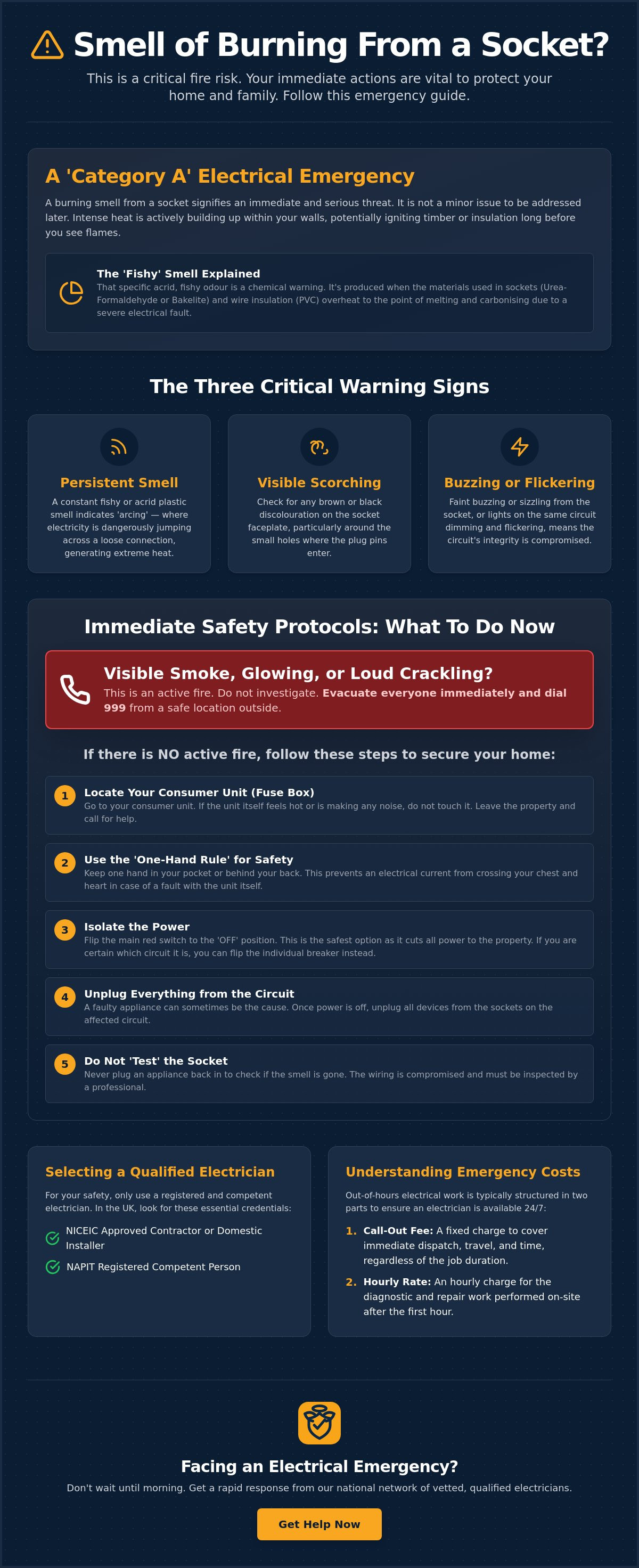
A smell of burning from socket is never a minor maintenance issue. It is a Category A electrical emergency. This classification means the risk to your property and personal safety is immediate. You don't need to see a visible flame for a fire to be active. Intense heat often builds up behind the plastic faceplate, reaching temperatures high enough to ignite internal timber studs or dust long before smoke appears. If you can smell it, the chemical breakdown of your electrical system has already begun.
Why does the smell often resemble rotting fish? Most UK sockets are made from urea-formaldehyde or Bakelite, whilst wire insulation is typically PVC. When these materials overheat due to a loose connection or an overloaded circuit, they release specific gases. This acrid, fishy odour is a definitive sign that plastic is melting and carbonising. Ignoring this scent can lead to catastrophic failure and increases the dangers of electrical injuries if you attempt to touch the affected area.
To better understand why your socket might be emitting these odours, watch this helpful video:
The "Big Three" Electrical Red Flags
Keep a sharp eye out for these specific warning signs that accompany the smell of burning from socket. If you notice any of these, the situation has escalated beyond a simple DIY fix.
- Persistent fishy or acrid plastic smells: This indicates arcing, where electricity jumps across a gap in a loose connection, creating intense localised heat.
- Visible scorching: Look for faint brown or black discolouration on the faceplate, especially around the plug pin entries.
- Flickering lights or buzzing: If lights on the same circuit dim when an appliance is plugged in, or if the socket itself is making a faint "sizzling" sound, the circuit integrity is compromised.
Triage: When to Call an Emergency Electrician
Does a burning smell always require a 24/7 response? Yes. Unlike a broken light switch or a faulty doorbell, a burning socket is an active fire hazard. Many homeowners worry about the cost of a midnight call-out and decide to wait until morning. This is a dangerous gamble. Electrical fires are often "silent" because they smoulder inside wall cavities, fueled by insulation and wooden joists. By the time the fire breaks through the plasterboard, it is often too late to contain it easily.
An emergency electrician arrives with thermal imaging tools to locate the exact heat source behind your walls. They can safely isolate the specific circuit, ensuring your family can sleep without the threat of a fire starting whilst you are unconscious. If the socket is hot to the touch or you see even a wisp of smoke, do not hesitate. Isolate the power at the consumer unit and call for professional help immediately.
Immediate Safety Protocols: What to Do Whilst You Wait
If you detect a smell of burning from socket, your priority is life safety. Stop everything. Don't waste time trying to "sniff out" the exact origin if the scent is strong. If the socket is visibly smoking, glowing, or emitting loud crackling sounds, do not call an electrician yet. Dial 999 immediately. Fire services across the UK warn that electrical fires can spread through wall cavities with terrifying speed. Evacuate your family and wait for the emergency services in a safe location outside.
If there is no smoke or fire, you must act to neutralise the electrical threat. Go to your consumer unit, often called the fuse box. Use the "one hand rule" by keeping one hand behind your back or in your pocket whilst operating the switches. This prevents an electrical current from travelling through your chest and heart if there is a fault within the box itself. Flip the main red switch to the "OFF" position. This kills all power to the property and is the safest way to ensure the smouldering stops immediately.
Isolating the Power Safely
If you are confident in identifying the specific circuit, you can flip the individual breaker labelled "Sockets" or "Ring Main". However, if the consumer unit itself feels hot to the touch or is making a sizzling noise, do not touch it. Leave the building at once. Once the power is successfully cut, unplug every appliance on the affected circuit. A faulty toaster or a cheap charger could be the source of the heat. Never "test" the socket by plugging a device back in to see if it still smells. You are dealing with a compromised system that requires a professional emergency electrician to assess the damage.
Preparing for the Engineer’s Arrival
Once the immediate danger is managed, prepare for the specialist's arrival to make the process as efficient as possible. Clear a direct path to the consumer unit and the faulty socket. Move any furniture, rugs, or clutter that might hinder the engineer’s access. Keep children and pets in a separate room or outside to ensure they stay away from the "danger zone".
Take a moment to document the details. When did you first notice the smell? What was plugged into that specific outlet? Was the appliance running at the time? This information is vital for the engineer’s diagnosis. Stay vigilant whilst you wait. Even with the power off, residual heat can linger in the walls. Keep a close eye on the area until the expert arrives to take full control of the situation.
Selecting a Qualified Emergency Electrician in the UK
You have isolated the power and managed the immediate risk. Now comes the critical task of choosing the right professional. When you report a smell of burning from socket, you aren't just looking for a repair; you are looking for a safety guarantee. Do not settle for a general handyman who "dabbles" in electrics. UK law is clear on domestic safety, and you need a specialist who is vetted, insured, and technically proficient.
Start by verifying their credentials. In England and Wales, look for engineers registered with NICEIC or NAPIT. If you are in Scotland, SELECT is the primary regulatory body. These organisations ensure that the electrician's work meets the high standards of BS 7671. Crucially, any domestic repair must be Part P compliant. This is a legal requirement under the Building Regulations, ensuring that the work is safe from fire and electrical shock. An unregistered worker cannot provide the necessary certification, which could invalidate your home insurance if a fire occurs later.
Be wary of lead-generation websites that appear local but actually sell your enquiry to the highest bidder. A genuine emergency responder will have a transparent identity and a clear process for dispatching engineers. Check for public liability insurance. This protects your property whilst the work is being carried out. If an engineer cannot prove they are insured for emergency call-outs, thank them and move on to the next provider.
Checking Professional Accreditations Quickly
How do you verify someone at 2 AM? Use the Registered Competent Person Electrical website. It is the definitive UK database for registered electricians. Enter the firm's name to confirm they are active members of a scheme. This simple check distinguishes a qualified professional from an amateur. Whilst a local presence is vital for a rapid response, ensuring that the individual adheres to national safety standards is what truly protects your home from a recurring smell of burning from socket.
Crucial Questions to Ask on the Phone
Be direct. Use these punchy questions to gauge their reliability before they depart for your property:
- "Does the quoted price include the first hour of labour?" Many services charge an "attendance fee" that covers nothing but the knock on the door. Clarity here prevents a shock when the bill arrives.
- "What is your realistic ETA right now?" Don't accept "as soon as possible". Ask for a time based on current traffic and demand in your specific postcode.
- "Will you issue a 'Make Safe' certificate?" If the damage is extensive and requires parts that aren't available until morning, the engineer must provide documentation proving they have left the installation in a safe state.
Emergency Call-Out Costs and Response Times Explained
The stress of a burning socket is often compounded by the fear of a massive bill. It's a common worry. However, when you detect a smell of burning from socket, the cost of inaction is far higher than a call-out fee. Understanding how the industry charges for out-of-hours work helps you manage your expectations and avoid predatory "cowboy" quotes. Why do midnight calls carry a premium? It's the price of having a specialist on standby to protect your home whilst others are asleep.
Emergency pricing typically follows a two-tier structure. You'll usually pay an initial attendance or call-out fee, followed by an hourly rate. Rates for bank holidays and late-night visits are higher than standard business hours because they require immediate dispatch. Be clear about the goal of the visit. In an emergency, the priority is a "Make Safe" intervention. This means the engineer will isolate the danger and ensure your property is not at risk of fire. A permanent repair, such as a full circuit rewire, might require a follow-up visit if specialised parts aren't available at 3 AM.
What Influences the Final Bill?
Several factors dictate the final invoice. Beyond the time spent on-site, you must consider the cost of emergency parts. If a socket faceplate or an RCD (Residual Current Device) has melted, the engineer will charge for the replacement hardware. Always ensure you receive a formal digital receipt. This isn't just for your records; it's a vital document for any future home insurance claims. Professionalism and transparency are the hallmarks of a reliable guardian for your home.
VAT is standard for most national services. A reputable engineer will be transparent about this from the start. If a quote seems suspiciously low or they insist on "cash only" without a receipt, consider it a red flag. You're paying for vetted expertise and legal compliance, not just a quick fix.
Typical Response Time Expectations
When your home is at risk, every minute feels like an hour. National dispatch centres work to a "Golden Hour" standard, aiming to get an engineer to your door as quickly as possible. Industry data shows that many national services strive to attend emergency call-outs within 90 minutes. This rapid response is essential for containing a smouldering fault before it escalates.
However, external factors can influence this. Heavy rain, road closures, or national grid fluctuations can impact travel times. A high-quality service will maintain clear communication, providing you with live updates so you aren't left waiting in the dark. If you need a rapid response to a faulty electrics emergency, choosing a service with a wide national network is the most effective way to minimise your wait time. Stay vigilant and keep the area clear until the expert arrives to take control.
Emergency Angel: National Rapid Response for Electrical Faults
When you are standing in your hallway at 2 AM with a smell of burning from socket, you don't need a salesperson. You need a first responder. Emergency Angel operates as a dedicated national network of vetted specialists who treat your domestic crisis with the urgency it deserves. We understand that an electrical fault isn't just an inconvenience. It is a threat to your home and your peace of mind. Our commitment is simple: we provide a rapid dispatch of qualified engineers to any UK postcode, ensuring help is never far away.
We pride ourselves on what we call "Qualified Friendliness." Our engineers possess the specialized knowledge to handle high-stakes situations whilst maintaining a calm, reassuring presence. You are not just another job number to us. You are a neighbour in need of protection. From the moment you contact our dispatch team, you will experience absolute transparency. We provide clear communication on arrival times and ensure there are no hidden fees or ambiguous costs. We focus exclusively on emergencies, meaning our engineers aren't tied up with planned home renovations. They are ready to move when you call.
Why Homeowners Trust Our Emergency Service
Safety is our primary objective. Our vetted professionals prioritise fire prevention and immediate risk mitigation above all else. Because we do not sell appliance retail or planned building works, our advice is always objective and focused on the immediate fault. We have seen every possible electrical failure and remain unfazed by complex issues. Our methodical approach to fault finding ensures that we don't just "patch" the problem. We secure your home for the long term.
- Vetted Professionals: Every engineer is checked for credentials and insurance before joining our network.
- Emergency Focus: We specialise in faulty electrics and urgent repairs, not general maintenance.
- Methodical Triage: We follow a strict protocol to identify arcing and overheating behind your walls.
- National Reach: Our network covers the entire UK, from urban centres to rural postcodes.
Restoring Safety to Your Home Tonight
The Emergency Angel process is designed for speed and efficiency. From your initial call, our dispatchers begin the triage process, gathering vital details about the smell of burning from socket to brief the attending engineer. Upon arrival, the specialist conducts a thorough safety check, identifies the heat source, and implements a "Make Safe" solution. Whether you are facing a total power loss or a smouldering outlet, we have the tools and the integrity to resolve the issue honestly. We don't leave until your installation is safe and your heart rate has returned to normal.
Don't leave your property's safety to chance. If you suspect an active electrical fault, take decisive action now. Our team is standing by to dispatch a local hero to your door. Book a Rapid-Response Emergency Electrician Now
Take Decisive Action to Protect Your Home
That acrid smell of burning from socket is a warning you cannot afford to ignore. You now have the knowledge to identify the specific fishy scent of overheating insulation and the steps to isolate your power safely. Don't let uncertainty or the worry of a midnight call-out fee stop you from acting. A smouldering fault behind your wall is an active fire risk that requires immediate, expert intervention whilst the situation is still manageable.
Emergency Angel provides the professional shield your home needs. We offer 24/7 national emergency coverage with a network of vetted NICEIC and NAPIT registered engineers. Our service is built on absolute transparency, featuring clear emergency call-out rates so you stay in control of the costs. We arrive with the right tools and the right integrity to fix the problem properly.
Secure a Rapid-Response Emergency Electrician Now
Your safety is our priority. Contact us today and let a local hero restore your peace of mind tonight.
Frequently Asked Questions
Is a burning smell from a socket always an emergency?
Yes, any burning scent from an electrical outlet is a critical emergency that requires immediate attention. It signals that internal components are overheating or arcing. This process can ignite a fire behind your walls long before you see visible flames. You must isolate the power immediately and contact a professional to prevent property damage or serious injury.
What should I do if I smell burning but cannot see any smoke?
Isolate the power at your consumer unit immediately even if smoke isn't visible. Smouldering often occurs inside the wall cavity where it is hidden from view. Once the power is off, unplug all appliances on that circuit. Don't wait for smoke to appear; the smell of burning from socket is your early warning sign to act fast.
How much does an emergency electrician call-out cost in the UK?
Costs for emergency call-outs vary depending on your location and the time of day. Most services charge an initial attendance fee followed by an hourly rate for labour. Expect to pay a premium for midnight calls, weekends, or bank holidays. Always ask for a clear breakdown of these charges before the engineer departs for your property to avoid surprises.
Can I just change the socket myself if it smells of burning?
No, you shouldn't attempt a DIY replacement in this situation. The smell often indicates a fault within the hidden wiring or a loose connection on the ring main, not just the plastic faceplate. A qualified engineer needs to test the circuit integrity to ensure the underlying cause is resolved. DIY repairs can leave your home at risk of a future fire.
Will my home insurance cover the cost of an emergency electrician?
Many home insurance policies include "Home Emergency Cover" as a standard feature or an optional add-on. This typically covers the call-out fee and initial labour to make the installation safe. Check your policy documents or contact your provider to see if they require you to use their approved engineers or if you can choose a specialist yourself.
How long does an emergency electrician take to arrive?
Most national emergency services aim to have an engineer on-site within 60 to 90 minutes. Arrival times depend on your specific postcode, current traffic conditions, and local demand at that time. A reliable service will provide you with a realistic ETA and keep you updated whilst the specialist is in transit to your home.
What is the most common cause of a burning smell from a plug?
Loose wiring connections are the most frequent culprit. When a wire is loose, electricity "arcs" across the gap, creating intense heat that melts the plastic casing. Overloading a socket with high-wattage appliances or using faulty adaptors can also cause the internal components to overheat. This leads to that distinctive acrid or fishy odour you might notice.
My fuse box has not tripped, but I still smell burning; what does this mean?
This means a fault is generating heat but hasn't yet reached the threshold to trigger a short circuit. Standard circuit breakers protect against overcurrent, but they don't always detect slow-smouldering heat caused by a loose connection. A smell of burning from socket without a tripped fuse is a dangerous fault that requires urgent professional investigation to prevent a fire.