

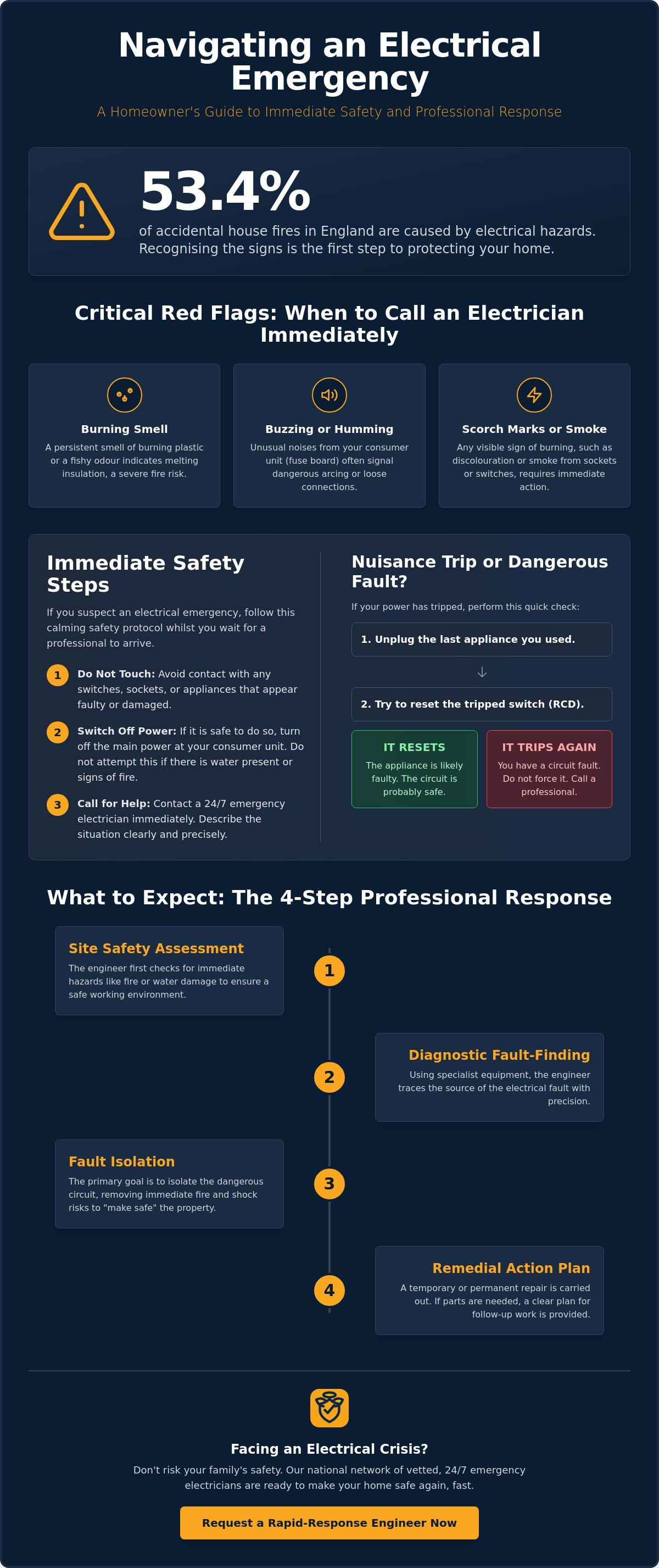
Did you know that electrical hazards cause 53.4% of all accidental house fires in England? It is a sobering fact. You might be standing in the dark right now, or perhaps you've noticed a worrying burning smell near your fuse board. That spike of adrenaline is your body's way of telling you something is wrong. You need an emergency electrician who can act fast. You're worried about your family's safety and the potential cost of a repair. We understand.
Finding a qualified professional shouldn't be a gamble during a domestic crisis. You need a first responder who treats your power loss with the urgency it deserves. This article explains how to manage critical failures and why rapid fault isolation is essential for your home's protection. We'll show you how to navigate urgent repairs whilst ensuring your property remains compliant with the latest BS 7671:2018+A4:2026 regulations.
We will outline the key warning signs of a dangerous fault and clarify how transparent call-out structures work. You will learn how to secure your home immediately and what a professional response looks like from start to finish.
Key Takeaways
- Identify "silent" warning signs like humming consumer units or burning smells that demand immediate professional attention.
- Master a calming safety protocol to protect your household whilst waiting for an emergency electrician to arrive.
- Understand the "make safe" priority where engineers focus on fault isolation to remove immediate fire and shock risks.
- Learn why 24/7 availability and a national network of engineers are critical for achieving rapid response times during a domestic crisis.
- Distinguish between urgent first-responder repairs and planned renovations to ensure you receive the correct level of professional care.
Recognising an Electrical Emergency in Your Home
What exactly constitutes a crisis? An electrical emergency isn't just a minor inconvenience like a blown bulb. It is any fault that poses an immediate risk of fire, electric shock, or a total loss of essential power to your property. If you're wondering What is an electrician? and why you need one right now, it's because these specialists possess the diagnostic tools to isolate hidden dangers. They act as first responders for your home's infrastructure.
Don't ignore the "silent" warnings. Your wiring often communicates distress before a fire breaks out. Buzzing or humming sounds coming from your consumer unit are never normal. These noises indicate loose connections or arcing, which generate intense heat. A persistent, acrid smell of burning plastic is the number one reason to call an emergency electrician immediately. This scent usually means cable insulation is melting behind your walls.
To better understand how to identify these hazards, watch this helpful video:
Check your neighbours' homes before you panic. If the whole street is dark, it's likely a network issue for the National Grid. However, if only your house is affected, the problem is internal. A fault within your own fuse box requires a professional response to prevent further damage. Prompt action saves lives and protects your property from the devastating effects of faulty electrics.
Critical Red Flags: When to Call 24/7
Act now if you see visible smoke or scorched marks on your plug sockets. These are signs of active combustion. A consumer unit that feels hot to the touch or emits loud cracking noises is a ticking time bomb. Sometimes, you might notice flickering lights paired with a strange fishy or ozone-like smell. This is a classic sign of overheating components. Don't wait for morning; your safety is the priority.
Nuisance vs. Danger: Evaluating Tripped Switches
Is it a faulty toaster or a failing circuit? If your power trips, try unplugging the last appliance you used. If the RCD resets, you've found the culprit. However, an RCD that refuses to stay in the "up" position suggests a deeper issue. Repeatedly forcing a tripped breaker back on is dangerous. It bypasses a safety feature designed to stop your house from burning down. If it won't reset, you need a professional diagnosis to find the underlying leak or short circuit.
What to Expect During an Emergency Electrical Call-Out
When the doorbell rings, you need more than just a person with a toolbox. You need a vetted professional who understands the high stakes of faulty electrics. A rapid arrival protocol is essential. Because we operate a national network, an emergency electrician can be dispatched to your door with the speed of a first responder. Their arrival marks the end of the panic and the beginning of a methodical, safe resolution.
The primary objective of this visit is to make the property "electrically safe". This doesn't always mean a full, permanent repair is completed within the first hour. Sometimes, the engineer must isolate a dangerous circuit or provide a temporary fix to restore essential power to your fridge or heating system. This allows you to breathe again whilst a permanent repair is scheduled. For peace of mind during these high-pressure moments, you can request a rapid-response engineer who prioritises your home's integrity.
The 4-Step Emergency Response Process
Efficiency is built on a strict protocol. First, the engineer performs a site safety assessment. They check for immediate hazards like water ingress or fire damage. Second, they use specialist diagnostic equipment to trace the fault. Third, they isolate the specific faulty circuit. This prevents the issue from affecting the rest of your home. Finally, they carry out remedial works or provide a clear, documented plan for follow-up repairs if specific parts are needed. Following these Immediate Safety Steps ensures that every action taken reduces the risk to your family.
Diagnostic Expertise: The Art of Fault-Finding
Finding the root cause of a power failure is often a hidden challenge. Problems rarely sit on the surface; they lurk behind walls or under floorboards. Our engineers use insulation resistance testing to identify degrading cables that are leaking current. This level of detail is vital for preventing future fires. They also ensure your consumer unit meets the latest safety standards, checking for proper RCD protection and secure connections. It's a comprehensive health check performed under emergency conditions.
Emergency Electrician vs. Standard Electrical Repairs
Understanding the difference between a planned upgrade and a critical intervention is vital for any homeowner. A standard electrician might book you in for next Tuesday to install a new light fitting or add a socket. This is scheduled maintenance. An emergency electrician, however, operates as a first responder. They are ready to deploy at 3:00 AM because electrical faults don't follow a nine-to-five schedule. When you are Recognising an Electrical Emergency, time is your greatest enemy. Waiting for a standard contractor during a power failure isn't just inconvenient; it's a gamble with your property's safety. You wouldn't wait for a scheduled appointment if your pipes burst; your wiring deserves the same level of urgency.
Maintaining a 24/7 rapid response requires a dedicated national network. It's about logistics and readiness. Whilst a local sole trader might be asleep or busy on a large site, a national service ensures an engineer is always on standby. This infrastructure is what allows for immediate fault isolation. Think of it as an investment in fire prevention. With electrical hazards causing 53.4% of accidental house fires in England, the cost of a call-out is minor compared to the potential loss of a home. Expert intervention stops a minor fault from becoming a catastrophic event.
Why "Out of Hours" Matters for Home Safety
Most people are tempted to "wait until morning" when they notice a flickering light or a warm switch. This is a dangerous mistake. Electrical fires can smoulder undetected within wall cavities for hours. Whilst your family sleeps, a small arc can ignite timber framing or insulation. A 24-hour response service removes this anxiety. It ensures that a professional can neutralise the threat before it escalates into a full-blown domestic disaster. Peace of mind comes from knowing the "silent" dangers are managed by an expert. You can't put a price on a safe night's sleep.
Planned Work vs. Urgent Intervention
It's helpful to distinguish the scope of work. Planned projects include full house rewires, EV charger installations, or aesthetic lighting upgrades. These are important for long-term value but don't require immediate action. Emergency work is different. It covers total power loss, water-damaged circuits, or sparking consumer units. At Emergency Angel, we focus exclusively on these high-stakes scenarios. Our goal is speed and safety, ensuring that faulty electrics are isolated and made safe without delay. We don't do renovations; we do rescues. When every minute counts, you need a specialist who prioritises your crisis over a standard kitchen refit.
Immediate Safety Steps Before Your Engineer Arrives
Take a deep breath. Your emergency electrician is already en route. During the first ten minutes of a domestic crisis, your primary role is containment and safety. High-stakes moments require a clear head. Follow this calming protocol to protect your household whilst our engineer travels to your location. If you haven't yet secured professional help, you can book an urgent response engineer here to take control of the situation.
The golden rule is simple: don't touch. If you see visible sparks, smoke, or charred equipment, keep a safe distance. Electrical current can arc through the air, especially in damp conditions. Never attempt to "investigate" a buzzing socket with a screwdriver or your bare hands. If it's safe to do so, locate your consumer unit and turn off the main isolation switch. This is usually the large red switch that kills power to the entire property. If the box is hot, making loud noises, or emitting a smell, stay away and wait for the professional.
Visibility is your next priority. Use a torch or your smartphone light to navigate your home. Avoid lighting candles at all costs. In a dark, high-stress environment, an open flame is a secondary fire risk you don't need. If you're dealing with total power loss, keep your fridge and freezer doors closed to preserve your food for as long as possible.
Securing the Area
- Protect vulnerable residents: Move children and pets to a different room away from the suspected fault centre.
- Prevent surge damage: If your lights are flickering or power is surging, unplug sensitive electronics like computers and televisions.
- Manage water ingress: If you suspect water from a leak has entered your electrics, do not enter the affected room. Water and electricity are a lethal combination.
Preparing for the Engineer’s Arrival
Speed is the objective once the engineer arrives. Ensure you have cleared a direct path to the consumer unit and your electric meters. If your fuse box is hidden in a cluttered cupboard or under the stairs, move any obstacles now. Having any previous EICR reports or electrical certificates to hand can also help the diagnostic process. Please clear a path to the main isolation switch so the engineer can begin work the moment they step through your door.
Why Emergency Angel is the UK’s Trusted Choice for Urgent Faults
Trust is the foundation of every rescue. When your home's safety is compromised, you don't just need a tradesperson; you need a guardian who understands the local area whilst backed by national resources. Our network ensures that an emergency electrician is never far away, regardless of whether you are in the heart of the Midlands or a coastal town in Wales. We have built our reputation on being the ultimate protector of the British home during critical failures. Every call is treated with the gravity of a first-response situation.
Our commitment to 24/7 availability is absolute. Electrical crises don't wait for business hours, so neither do we. By maintaining a constant state of readiness, we eliminate the stress of searching for help at 3:00 AM. You aren't just calling a call centre; you are activating a safety network designed to secure your property and your family. This dedication to rapid fault isolation is what sets us apart as a leader in the industry.
National Reach, Local Expertise
We coordinate engineers across the country to ensure rapid dispatch times that local sole traders simply cannot match. Unlike competitors who focus solely on London, we believe every household in the UK deserves a first-responder service. Our focus remains exclusively on urgent work. We don't get distracted by planned renovations or appliance retail. This "emergency only" model makes our response more efficient. You get the personal touch of a local engineer who is vetted to a rigorous national standard. It is the best of both worlds: local heart with national muscle.
Commitment to Transparency and Safety
We use a "no fluff" approach. When things go wrong, you don't need complex technical jargon or vague estimates. You need a clear explanation of the fault and a decisive plan to fix it. We prioritise the most dangerous calls, such as those involving faulty electrics that pose a high fire risk. Our engineers are trained to identify hazards and ensure compliance with the latest BS 7671:2018+A4:2026 standards. This keeps your home safe and your insurance valid.
Don’t leave your safety to chance. If you are experiencing a critical failure right now, contact Emergency Angel for immediate assistance. Our team is standing by to restore your power and your peace of mind.
Secure Your Home with Rapid Fault Isolation
Electrical emergencies are high-stakes events that require immediate, professional control. You now know how to identify the silent warnings of a failing system and the critical safety steps to take whilst waiting for help. Whether it's a total power loss or a worrying scent of burning plastic, acting fast is the only way to protect your property and your family. Expert intervention stops a minor fault from becoming a catastrophe.
Our UK-wide rapid response network is designed to lower your heart rate and restore your safety. We provide vetted professional engineers who are ready to deploy at any hour, day or night, for all domestic emergencies. Don't leave your protection to chance or wait for a standard contractor during a crisis. If you suspect a dangerous fault, you need an emergency electrician who treats your home with the urgency it deserves.
Book a 24/7 Emergency Electrician Now
Stay vigilant and trust the experts to keep your wiring secure. We are ready to help when you need us most.
Frequently Asked Questions
What is considered an electrical emergency at home?
An electrical emergency is any situation posing an immediate threat to your safety or property. This includes visible sparks, a persistent burning smell, or a total loss of power that leaves you without heating or light. Exposed wiring, water ingress into your electrical system, or a consumer unit that is hot to the touch are also critical crises that demand a rapid response.
How quickly can an emergency electrician arrive at my property?
Our national network is built for speed, allowing us to dispatch a local engineer to your door with first-responder urgency. Whilst arrival times can vary based on your specific location and current demand, we prioritise the most dangerous faults to ensure home safety. Our coordination centre works around the clock to ensure the nearest available professional is sent to your property immediately.
How much does an emergency electrician call-out cost in the UK?
Pricing for urgent work typically reflects the 24/7 readiness and specialised diagnostic skills required for first-response repairs. Most services involve a call-out fee combined with an hourly rate, which may be higher during nights, weekends, or bank holidays. We believe in transparency and will ensure you understand the fee structure before an emergency electrician is dispatched to your home.
What should I do if I smell burning but can’t see any fire?
Isolate your main power switch immediately if it is safe to do so. A burning plastic or acrid scent often indicates that cable insulation is melting behind your walls or within a socket. This is a major fire risk that can smoulder undetected. Once the power is off, call for professional assistance to locate and neutralise the hidden fault before it ignites.
Can I fix a tripped fuse box myself or do I need an engineer?
You can attempt to reset a tripped switch once, provided you have unplugged the appliance that caused the issue. However, if the breaker trips again immediately or refuses to stay in the "on" position, you have a serious circuit fault. Never force a switch to stay up. This bypasses a life-saving safety feature and requires a professional engineer to diagnose the underlying faulty electrics.
Is a power cut an electrical emergency that you can help with?
We specialise in domestic power cuts caused by faults within your own property's wiring or consumer unit. If your neighbours have power but your home is dark, the problem is likely internal and requires our help. If the entire street is affected, this is a grid-level issue. In that case, you should call 105 to reach your local network operator instead.
Are your emergency electricians qualified and insured?
Every engineer in our network is fully qualified and carries comprehensive insurance to protect your home. We operate a rigorous vetting process to ensure that only registered professionals with the correct expertise handle your emergency electrician needs. All works are carried out to meet the latest UK safety standards, ensuring your property remains compliant and safe.
What happens if the electrician can’t fix the fault immediately?
The engineer's first priority is to make your property "electrically safe" by isolating the dangerous fault. If a permanent repair requires specialised parts not carried on the van, they will ensure the immediate risk of fire or shock is removed. You will then be provided with a clear plan and a quote for the follow-up work needed to restore your system to full capacity.