
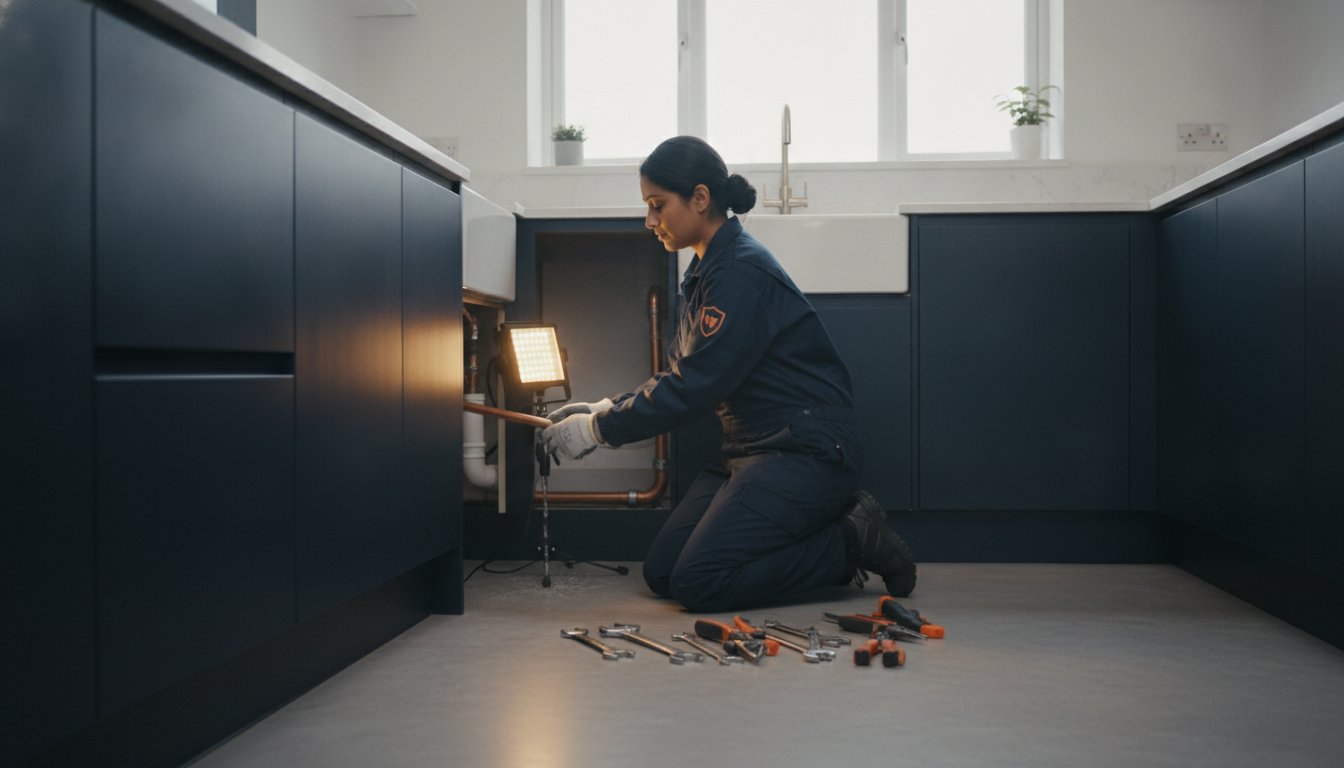
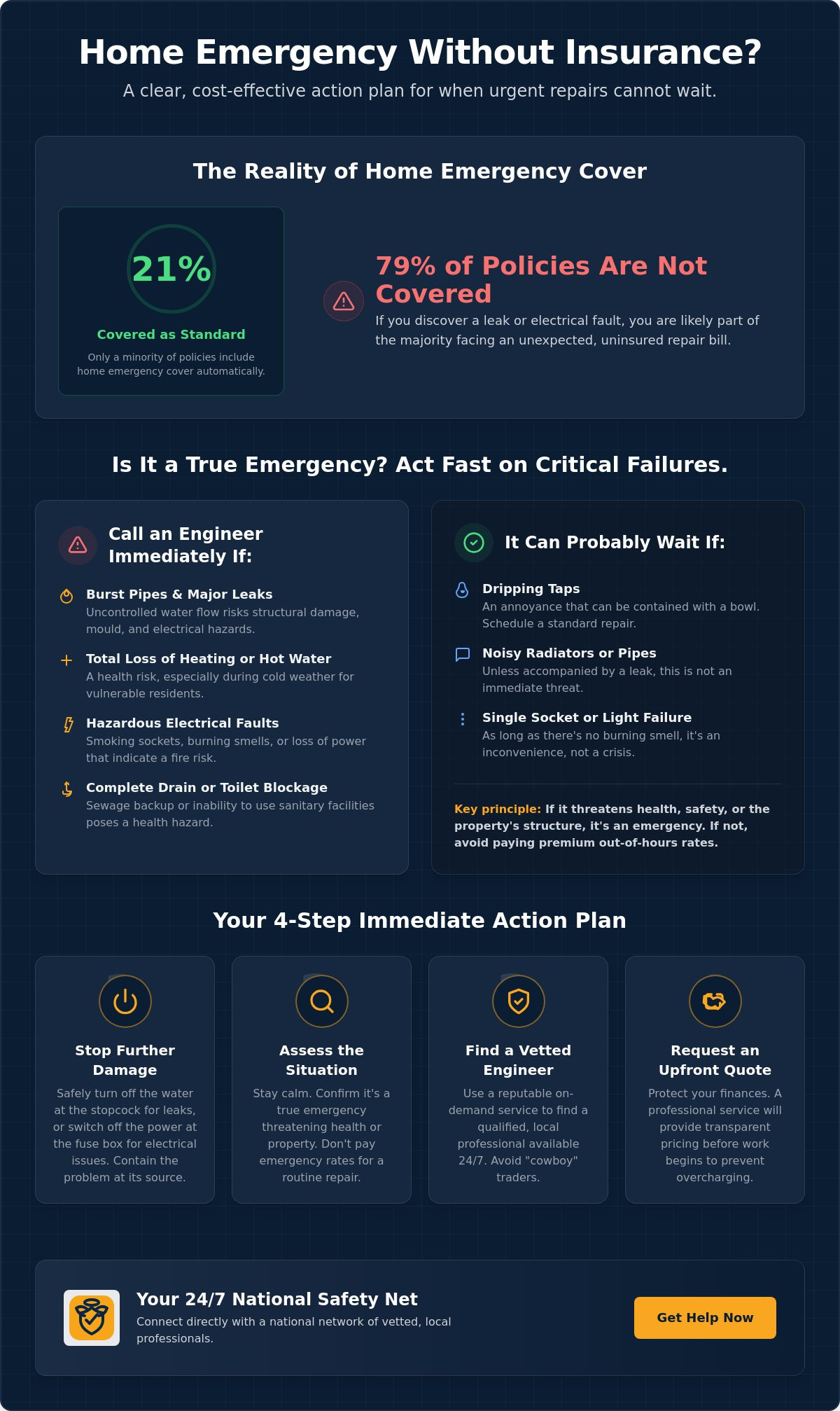
Did you know that only 21% of buildings insurance policies actually include home emergency cover as standard? If you've just discovered a spraying pipe or a cold radiator, finding out you're part of the other 79% is a moment of pure panic. Facing a home emergency without insurance is a high-stakes situation, but it doesn't have to lead to a financial disaster.
We understand the anxiety of a domestic crisis. You're likely worried about water damage spreading, the cost of an out-of-hours call-out, and the risk of being exploited by "cowboy" tradespeople. You need to secure your home tonight without being overcharged for the privilege. You can resolve the crisis quickly and professionally by following a clear, decisive plan. It's about taking control of the situation before the damage gets worse.
This 2026 guide shows you how to manage urgent repairs cost-effectively. You'll learn how to identify a true emergency, find vetted engineers with transparent pricing, and explore available grants to help cover the bill. Let's get your home back under control right now.
Key Takeaways
- Define a true domestic emergency to ensure you only pay for repairs that protect your health or property integrity.
- Discover how on-demand services offer a faster, more transparent alternative to traditional monthly insurance premiums.
- Protect your finances by learning how to request upfront, transparent quotes and avoid the risk of being overcharged.
- Follow a four-step immediate action plan to stop damage at the source and secure your home tonight.
- Manage a home emergency without insurance by connecting directly with a national network of vetted, local professionals.
What defines a home emergency when you aren't insured?
A domestic crisis doesn't wait for a convenient time. When you're facing a home emergency without insurance, the first challenge is deciding if the problem is a "true" emergency or just a costly inconvenience. An emergency is any sudden event that threatens your health, compromises the integrity of your property, or cuts off essential services like water and power. Think of it as the immediate response phase in the principles of emergency management. You need to act fast to mitigate damage, but you must remain methodical. A burst pipe spraying water near your fuse box is a crisis. A dripping tap is a job for next Tuesday.
Common scenarios that demand immediate attention include:
- Burst pipes: Uncontrolled water flow that can saturate floors and ceilings.
- Total loss of heating: A boiler failure during cold weather that puts residents at risk.
- Hazardous electrical faults: Smoking sockets, burning smells, or loss of power to essential circuits.
- Blocked drains: External sewage backups or internal blockages that prevent sanitary use of the home.
Identifying critical failures vs. routine repairs
How do you know when to call an engineer? Look for immediate threats. Total loss of heating during a cold snap isn't just uncomfortable; it's a health risk for vulnerable residents. Hazardous electrical faults, such as smoking sockets or flickering lights accompanied by a burning smell, require an emergency electrician immediately. Plumbing issues like a major leak or a completely blocked drain that prevents you from using your toilet are critical. If the issue can be contained with a bucket and doesn't pose a safety risk, it's a routine repair. Don't pay emergency rates for a job that can wait for a standard appointment.
The risks of delaying emergency repairs
Delaying action often costs more than the call-out fee. Water is relentless. A small leak hidden behind a wall can lead to structural rot or black mould within days. These issues are expensive to remediate and can affect your family's respiratory health. Faulty electrics carry the risk of fire or electrocution. By addressing the problem now, you stop the immediate damage to the property. It's the difference between a quick repair and a major restoration project. When you handle a home emergency without insurance, your priority is containment. Secure your home tonight to avoid long-term financial strain and health hazards.
Maintaining a calm approach is vital whilst the situation unfolds. Panic leads to poor decisions and the risk of hiring the first person who answers the phone, regardless of their qualifications. Take a breath. Assess the damage. If the failure threatens the safety of your family or the structure of your house, it's time to find a professional. You don't need a monthly policy to get expert help; you just need a clear head and a reliable contact.
On-demand repairs: The alternative to home emergency cover
On-demand repairs operate on a refreshingly simple principle: you pay for the expertise you use, exactly when you need it. This pay-as-you-go model is the direct alternative to traditional insurance policies that lock you into monthly premiums. When you face a home emergency without insurance, you aren't stuck waiting for a corporate giant to approve a claim. You have the freedom to choose your own vetted engineer. This model prioritises your needs over policy fine print. It's particularly effective for well-maintained, modern homes where the likelihood of a major failure is low, making fixed monthly costs a poor investment.
How pay-as-you-go emergency services work
The process is built for speed. It starts with a single point of contact. You report the issue, and an engineer is dispatched immediately. There's no middleman and no lengthy verification process. This "first responder" approach mirrors how emergency services operate. The focus is entirely on the physical resolution of the crisis. Because these services are built around 24/7 availability, you get an immediate response regardless of the hour. You aren't just a policy number; you're a neighbour in need of a professional fix. If you find yourself in a crisis tonight, connecting with a local engineer can stop the damage before it escalates.
Why some homeowners choose not to insure
Many UK homeowners are opting out of traditional cover to avoid "premium creep." This is the frustrating trend where your monthly costs rise every year, even if you never call for help. Adding emergency cover to a standard policy costs an extra £41 a year on average, yet many of these policies have strict limits on what they'll actually fix. Instead of losing money to an insurance firm, many prefer building an emergency fund that remains under their own control. This strategy ensures your money stays in your pocket until it's actually needed for a repair.
Direct communication is another major advantage. When you handle a home emergency without insurance, you speak directly to the people doing the work. You don't have to deal with a detached call centre that doesn't understand your local area. You maintain absolute control over who enters your property. You aren't forced to accept whichever firm the insurer has the cheapest contract with. You get a qualified professional who's accountable to you, not an insurance adjuster. It's a more personal, transparent, and ultimately faster way to secure your home.
Managing the cost of emergency repairs without a policy
Financial transparency is the most effective tool for lowering your heart rate during a crisis. When you're facing a home emergency without insurance, the fear of an open-ended bill can be as stressful as the leak itself. You aren't just paying for a person to turn a spanner; you're paying for immediate availability, specialized diagnostic tools, and years of vetted expertise. A professional service should be able to provide a clear explanation of their charging structure before the van even leaves the depot. This clarity allows you to make an informed decision under pressure, ensuring you stay in control of your budget whilst securing your property.
Understanding call-out fees and hourly rates
Professional engineers operate on a structure that reflects the urgency of the situation. Out-of-hours rates are naturally higher because they require staff to be on standby during evenings, weekends, and bank holidays. A standard emergency fee typically covers the time and fuel for the engineer to arrive and diagnose the fault. A call-out fee is the fixed cost for professional diagnostic arrival. Once the issue is identified, the engineer should provide a breakdown of the labour and parts required to resolve the crisis. Always ask if the initial fee includes the first hour of labour, as this varies between providers.
Avoiding the rogue trader trap
Pressure creates opportunities for "cowboy" builders. When booking an emergency repair online, watch for red flags like a lack of a physical address, no landline number, or a refusal to provide a written quote. Quality is non-negotiable when your safety is at stake. For any gas-related issue, you must verify that the engineer is on the Gas Safe Register. Similarly, electrical work should be carried out by someone with NICEIC or equivalent UK registration. These certifications aren't just badges; they're your guarantee that the work meets strict national safety standards. A reputable national service vets their engineers so you don't have to do the background checks in the middle of the night.
It's important to distinguish between an emergency "make safe" and a permanent renovation. In a crisis, the priority is to stop the immediate damage, such as capping a leaking pipe or isolating a dangerous circuit. This "first responder" fix secures your home tonight. You can then plan and budget for a permanent, non-emergency repair at a later date. This staged approach prevents you from making expensive, impulsive decisions about your home's long-term maintenance. Regular servicing of your boiler and electrical inspections can significantly reduce the risk of these high-stakes failures occurring in the first place.
4 Steps to handle a home emergency right now
Facing a home emergency without insurance requires a cold head and fast hands. You don't have a claims line to call, so you are the site manager for the next ten minutes. Your goal is simple: stop the damage from getting worse. Following a logical sequence ensures nothing is missed during the adrenaline spike of a crisis. Speed is your best defence against rising repair costs.
- Isolate the source: Kill the flow of water, gas, or power immediately.
- Document the scene: Use your phone to record the damage before any work starts.
- Call for professional backup: Contact a rapid-response service to get an engineer in transit.
- Prepare the work area: Clear a path so the engineer can start work the second they arrive.
Immediate isolation tactics for homeowners
Stop the flow before it ruins your flooring. Most internal stopcocks are located under the kitchen sink or in a hallway cupboard. Turn the handle clockwise until it stops to kill the water supply. If you suspect an electrical fault, head to your consumer unit. Switch off the "Main Switch" to cut all power if you're unsure which circuit is compromised. Smelling gas? This is a life-threatening situation. Evacuate everyone from the property immediately. Do not use light switches, naked flames, or your phone inside. Call the National Gas Emergency Service from the safety of the street.
Vetting an engineer in under five minutes
You need a professional, not a cowboy. Ask three critical questions before the engineer departs: Are you Gas Safe or NICEIC registered? What is the total call-out fee including VAT? How soon will you be at my door? When the engineer arrives, ask to see their ID card before letting them in. A genuine professional expects this and will have their credentials ready. They should focus on a "make safe" procedure to neutralise the immediate risk. This stops the clock on the damage and gives you breathing room to discuss permanent solutions. If you need a vetted professional at your door immediately, book an emergency engineer now to secure your property.
Whilst you wait for the van to arrive, clear the area. Move furniture, lift rugs, and mop up standing water if it is safe to do so. Ensuring the engineer has direct, unobstructed access to the fault saves valuable time. Every minute they spend moving your boxes is a minute they aren't fixing the problem. By taking these decisive steps, you manage a home emergency without insurance like a professional. You've contained the crisis, protected your property, and secured a qualified engineer at a transparent price.
Emergency Angel: Your 24/7 national safety net
When a crisis is unfolding, you don't have time to browse directories or wait for insurance adjusters. Handling a home emergency without insurance requires a partner who understands the high stakes. We operate as a first responder for your property. Our focus is absolute: we secure your home and stop the damage fast. There are no monthly premiums to pay and no prior policies required. You get direct access to professional relief exactly when you need it. We arrive when things go wrong, possessing the specialized knowledge to fix the issue and the integrity to be honest about the process.
Professional rapid response for every failure
Our network covers the most critical domestic failures across the UK. If your boiler fails during a freeze, our emergency heating engineer and emergency boiler repair specialists are ready to restore your warmth. Dealing with faulty electrics? Our emergency electrician team handles hazardous circuits, smoking sockets, and total power loss at any hour. For external crises, our drainage engineers resolve blocked systems and sewage issues that threaten your property's hygiene. We specialise in plumbing emergency situations and heating issues, ensuring that every critical system in your home has a dedicated expert on standby. This isn't just a repair; it's professional crisis management designed to lower your heart rate.
Transparent pricing for peace of mind
Stress shouldn't be compounded by financial ambiguity. We've removed the complex insurance jargon and hidden fees that often plague the industry. You receive a clear, upfront explanation of costs before the work begins. Our engineers embody "qualified friendliness." They possess the technical expertise to fix the problem and the professional calm to reassure you throughout the process. We value our reputation among neighbours and take our role as protectors of the home seriously. This sense of accountability means we treat your property with the same care we'd give our own. You aren't just a customer; you're a homeowner in need of a local hero.
Every minute counts during a domestic crisis. Don't let a minor failure turn into a structural disaster whilst you search for a reliable firm. We focus exclusively on urgent repairs to get your life back to normal. If you are managing a home emergency without insurance, you need a service that is fast, reliable, and honest about the process. We remain unfazed by the complexity of the repair, providing a methodical and accelerated path to resolution. Contact Emergency Angel now for immediate assistance and let us secure your home tonight.
Secure Your Home and Stop the Damage Tonight
Domestic crises are unpredictable, but your response doesn't have to be. You now know how to distinguish a critical failure from a routine repair and the essential steps to isolate a hazard before it escalates. Skipping expensive monthly premiums doesn't mean you have to compromise on the safety of your property. Managing a home emergency without insurance is a straightforward process when you choose a transparent, on-demand service that prioritises your needs over policy fine print.
You can secure your property right now with the help of experts who value accountability and speed. We provide 24/7 Rapid National Response with Gas Safe and NICEIC registered engineers. There is no insurance required and no hidden fees; just professional relief when you need it most. Don't let a burst pipe or a heating failure dictate your night. Take decisive action to protect your home and your budget.
Book a Professional Emergency Engineer Tonight
Your home is your most important asset. By following a methodical plan and calling in vetted experts, you've already taken the hardest step toward a resolution. We are ready to help you get things back to normal.
Frequently Asked Questions
Is it cheaper to have home emergency insurance or pay as you go?
It depends on the age of your property and your risk tolerance. Insurance involves a fixed annual cost, whilst pay-as-you-go means you only pay when a failure occurs. For many with well-maintained homes, paying for a home emergency without insurance is more cost-effective than decades of unused premiums. You avoid "premium creep" and only fund the repairs you actually need.
What is the average response time for an emergency plumber without insurance?
Response times for on-demand plumbers are typically between one and four hours depending on your location. Unlike insurance firms that must juggle thousands of policyholder claims, local on-demand services prioritise immediate dispatch. This "first responder" approach ensures an engineer is at your door quickly to stop the immediate damage to your property.
Can I call an emergency electrician if I do not have a cover policy?
Yes, you can call an emergency electrician at any time without a prior policy. On-demand services provide direct access to qualified professionals who handle faulty electrics and hazardous circuits on a pay-per-job basis. You retain full control over who enters your home and receive a transparent quote before the work begins.
Will my standard home insurance cover a burst pipe if I do not have emergency cover?
Standard buildings insurance usually covers the cost of repairing the damage caused by a leak, such as ruined carpets or plaster. However, it rarely covers the actual plumbing repair to the pipe itself. Without specific emergency cover, the cost of the engineer's call-out and the physical pipe repair remains your responsibility.
What happens if a boiler breaks down and I am not insured?
You simply hire a private emergency heating engineer to attend the failure. They will perform a "make safe" procedure or a full repair depending on the fault and parts available. Handling a home emergency without insurance in this way gives you the freedom to choose your own vetted engineer rather than waiting for a firm assigned by an insurer.
How do I know if a tradesperson is qualified for an emergency gas repair?
Always check their physical Gas Safe ID card the moment they arrive at your door. You can also verify their registration number on the official Gas Safe Register website. For electrical work, ensure the professional holds NICEIC or NAPIT certifications to guarantee the work meets strict UK national safety standards.
What should I do first if I have a major leak but no insurance?
You must isolate the water supply at the internal stopcock immediately to stop the flow. This valve is usually located under the kitchen sink or in a hallway cupboard. Once the water is off, document the damage with photos for your records and contact a professional on-demand repair service for an immediate call-out.
Are emergency drainage services available 24/7 for non-insured customers?
Yes, emergency drainage services are available 24/7 for all homeowners regardless of their insurance status. Specialist drainage engineers can be dispatched at any hour to resolve blocked systems or sewage issues. These services operate on a transparent, pay-as-you-go basis to get your home's essential services back to normal fast.