
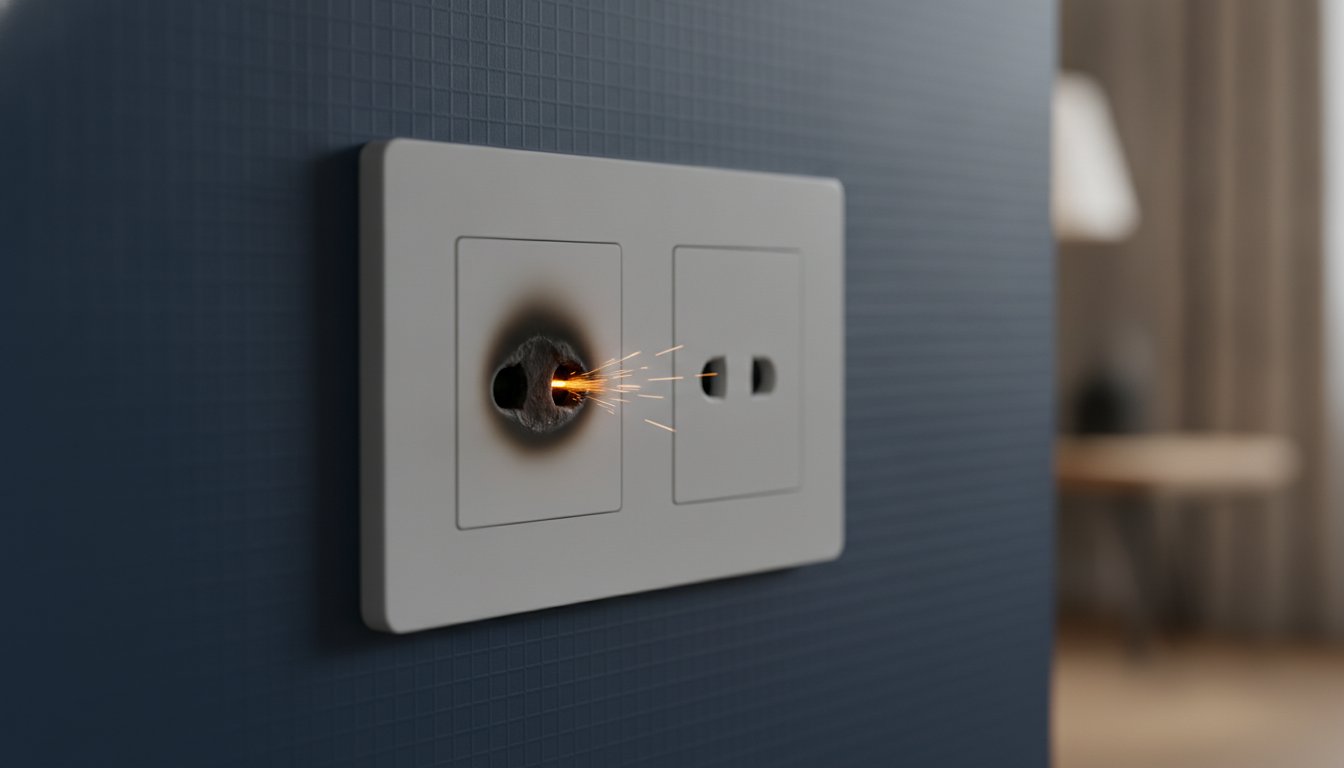
You’re sitting in your living room when a faint, fishy smell drifts past, or perhaps a light switch emits a sharp crackle as you flick it. Is it a minor nuisance or the start of a house fire? Recognising the specific signs of electrical fault in home is the only way to protect your household from these silent hazards. It’s natural to feel anxious when your wiring starts acting up; you don't want to ignore a genuine threat, but you also want to avoid unnecessary emergency call-out costs.
We understand that you need clear, decisive answers to lower your heart rate and secure your property. This guide removes the guesswork by helping you identify high-risk warnings before they become domestic disasters. You’ll learn exactly how to triage your electrical issues using a step-by-step safety protocol. We will also preview the latest 2026 safety standards from BS 7671 Amendment 4, including the vital role of Arc Fault Detection Devices (AFDDs), so you know exactly when it’s time to call for professional help.
Key Takeaways
- Recognise the "silent" nature of electrical degradation behind walls to prevent hidden hazards from becoming emergencies.
- Identify the critical signs of electrical fault in home, including persistent fishy smells and charred socket outlets.
- Apply the "Rule of Three" framework to distinguish between minor electrical nuisances and high-risk fire threats.
- Master the immediate safety protocol for isolating power and reducing circuit load whilst waiting for an expert.
- Discover when to call for a rapid-response Emergency Electrician to resolve complex faulty electrics safely.
Signs of Electrical Fault in Your Home: Why Early Detection Saves Lives
An electrical fault isn't always a dramatic explosion or a shower of sparks. In a modern UK home, a fault is any failure within your wiring, accessories, or protective devices that prevents electricity from flowing safely. These issues are often invisible. They hide behind your walls, within ceiling voids, and beneath floorboards. This silent degradation is exactly why identifying the signs of electrical fault in home early is a matter of life and death.
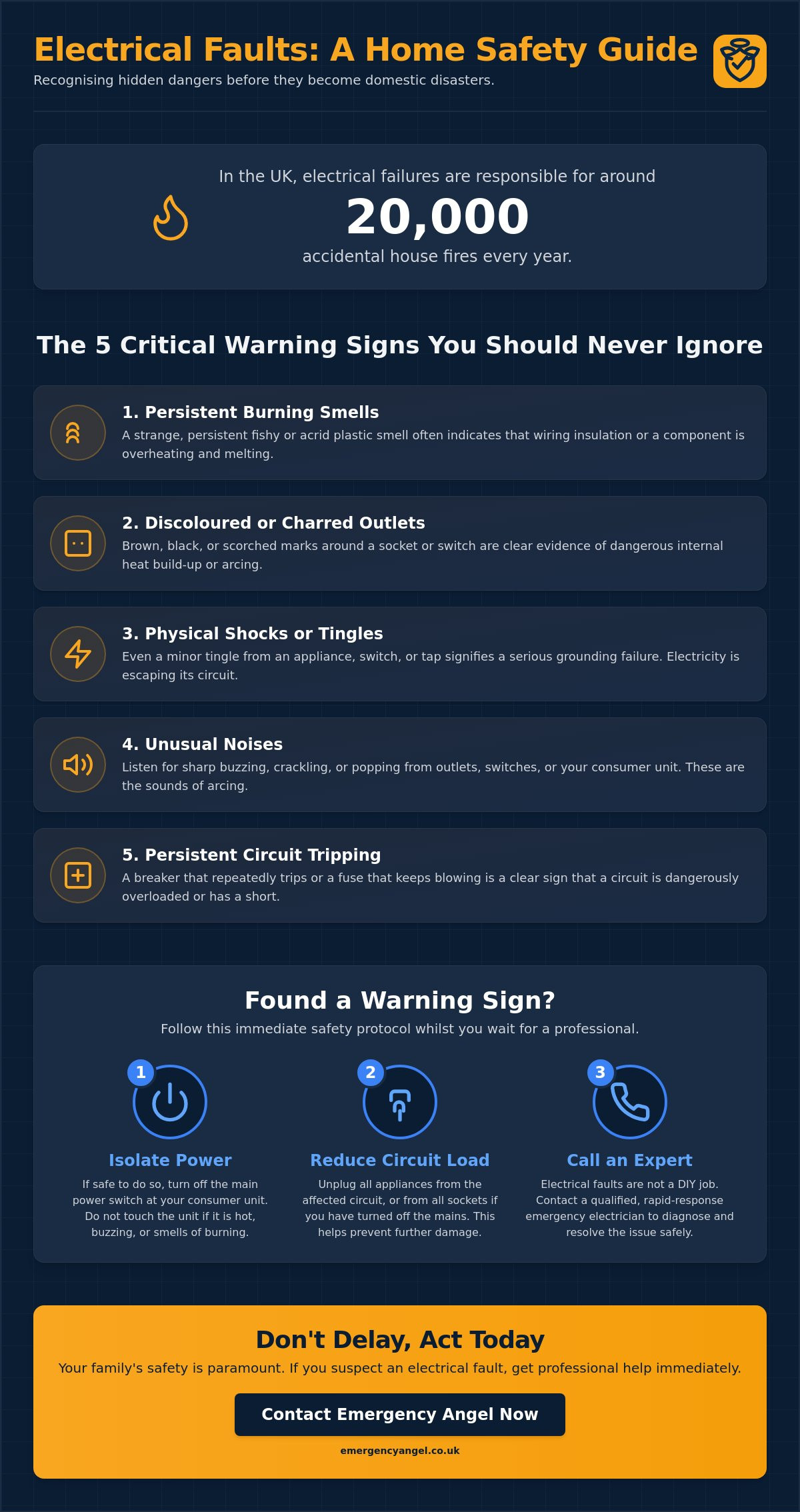
Current UK fire statistics are sobering. Electrical failures are responsible for approximately 20,000 accidental house fires every year. These aren't just statistics; they represent homes lost and lives put at risk due to preventable wiring failures. Your primary line of defence is the consumer unit. It’s designed to detect abnormalities and kill the power instantly. If it’s outdated or failing, that safety net disappears. You need to know what to look for before the smoke starts.
The Hidden Danger of Outdated Wiring
Wiring has a shelf life. Most domestic installations are designed to last around 25 years before they require a full professional assessment or a complete rewire. You can often spot the age of your system by looking at the cables near your consumer unit. Are they covered in black rubber? This material, common before the 1960s, becomes brittle and flakes away over time, leaving bare copper exposed. Modern systems use grey or white PVC insulation, which is far safer but still subject to wear and tear.
DIY 'handyman' fixes are another major hazard. We often find properties where previous owners have bypassed safety protocols or ignored the UK wiring regulations to save a few pounds. These botched jobs are ticking time bombs. If your wiring looks like a tangled nest or uses mismatched cables, it’s a high-priority risk that needs immediate attention from an expert.
The Consumer Unit: Your Home’s First Responder
Think of your consumer unit as a first responder. Its job is to react to a crisis before you even know it's happening. There is a vital difference between a circuit 'tripping' and a total system failure. A trip usually means the system is protecting you from an overload or a faulty appliance. However, if the unit itself is the source of the problem, you’re in immediate danger. If your power cuts out and won't reset, don't force it. The system is telling you something is wrong.
Watch out for these red flags at the fuse box:
- Persistent Buzzing: A crackling or humming sound indicates loose connections or internal arcing.
- Physical Warmth: The plastic casing should never feel hot to the touch. Heat suggests a serious resistance issue.
- Burning Smell: An acrid, plastic odour near the unit is an immediate emergency.
The 5 Critical Warning Signs You Should Never Ignore
Identifying the signs of electrical fault in home isn't just about maintenance; it's about survival. Some warnings are subtle. Others are impossible to ignore. If you experience any of the following, your home is likely already in a state of crisis. Electricity is a controlled force, and once it breaks its boundaries, the risk of fire or lethal shock becomes an immediate reality.
- Persistent Burning Smells: It isn't the bins. If you notice a strange, fishy odour or an ozone-like scent, your wiring is melting.
- Discoloured Outlets: Brown or black charred marks around plug sockets are evidence of internal arcing. This violates safety standards in the Electrical Equipment (Safety) Regulations 2016, which mandate that equipment must not endanger property.
- Physical Shocks: Never ignore a "tiny tingle" when touching a toaster or a tap. This indicates a grounding failure. Electricity is looking for a path to the earth through you.
- Unusual Noises: A faint hum is normal; a sharp buzzing, crackling, or popping sound is not. These are the literal sounds of electricity escaping its intended path.
- Persistent Tripping: A circuit breaker that won't reset is a safety device doing its job. Don't keep flipping it back up. It’s a cry for help from a circuit under extreme stress.
The "Fishy" Smell: A Sign of Melting Plastic
When PVC insulation or socket housings overheat, they release a specific chemical signature that smells remarkably like fish. This smell often precedes a visible fire by hours or even days. If you catch this scent, don't wait for smoke. Isolate the affected circuit at the consumer unit immediately. If you're unsure which circuit is the culprit, a specialist in faulty electrics can provide the rapid diagnostic you need to prevent a disaster.
Modern High-Load Faults: EV Chargers and Heat Pumps
Our homes are changing rapidly. By 2026, the widespread adoption of EV chargers and heat pumps has placed unprecedented demand on older UK wiring. A standard 13A socket is not designed for the prolonged, heavy draw required by this modern technology. Look for warped plastic or heat damage on dedicated appliance isolators. These high-load faults are the leading edge of domestic electrical risks in 2026, often caused by installations that haven't been upgraded to meet the increased demand.
Flickering Lights: Nuisance or Nightmare?
Is it just a loose bulb? If the flickering happens when you turn on the kettle, or if it affects multiple rooms, you have a serious supply issue. It often points to a loose neutral wire in the consumer unit or arcing within ceiling roses and light switches. This is a nightmare scenario that can lead to a total system burnout. Unlike a single bulb failure, flickering across the house suggests the integrity of your entire electrical system is compromised.
Nuisance or Danger? Categorising Your Electrical Faults
Is that flickering light a minor annoyance or a house fire in the making? Most homeowners struggle to distinguish between a simple maintenance task and a genuine emergency. To protect your property, you need a clear triage framework. You shouldn't have to guess when your safety is on the line. Understanding the specific signs of electrical fault in home allows you to act with precision rather than panic.
The "Rule of Three" is a reliable way to assess risk. One isolated issue, like a single bulb blowing, is often just a nuisance. However, when you notice three or more symptoms simultaneously, you are facing a systemic failure. For instance, if you have a flickering light, a socket that feels warm, and a faint buzzing sound, your wiring is under extreme stress. These clusters are never a coincidence. They indicate that the safety margins of your installation have been breached.
Intermittent problems are particularly deceptive. If a fault "disappears" on its own, it hasn't actually gone away. It usually means the arcing or overheating is only occurring when the circuit is under a specific load. This is why the HSE electrical safety guidance emphasises that faults must be investigated by competent persons before they escalate into disasters. For homeowners, an Electrical Installation Condition Report (EICR) is the only way to uncover these hidden dangers. It provides a professional "health check" for the wiring you cannot see.
Emergency vs. Non-Urgent Faults
An electrical emergency involves an immediate risk to life or property. If you see smoke, smell burning plastic, hear loud crackling, or experience a total loss of power that isn't a regional grid failure, you need an emergency electrician immediately. Conversely, a single dead outlet or a cracked faceplate with no exposed wires is non-urgent. These issues still require professional attention, but they don't require a midnight call-out. Recognising these signs of electrical fault in home helps you manage your budget whilst keeping your family safe.
The Danger of the "Quick Fix"
Electrical tape is not a permanent solution for 240V wiring. DIY patches are a primary cause of domestic fires and can lead to your home insurance being invalidated. In the UK, most electrical work must comply with Part P of the Building Regulations. This is a legal requirement to ensure that work is carried out by a registered professional. Cutting corners with "handyman" fixes puts your family at risk and leaves you legally vulnerable. Always ensure any remedial work is certified to maintain your home's safety and value.
Immediate Safety Protocol: What to Do Whilst Waiting for an Electrician
Once you have identified the signs of electrical fault in home, the next 30 minutes are critical. You have already made the right choice by calling for professional help. Now, you must secure the area. Your goal is to prevent a minor fault from escalating into a full-scale fire whilst the engineer is in transit. Following a disciplined protocol ensures you remain in control of the situation.
- Isolate the power. If you can safely reach the consumer unit, turn off the main switch. This stops the flow of energy to the entire property instantly.
- Unplug high-load appliances. Remove kettles, portable heaters, and EV chargers from their sockets. This reduces residual stress on the internal wiring.
- Clear the path. Move furniture or clutter away from the consumer unit and the suspected fault area. Every second counts when an engineer arrives.
- Hands off. Never touch charred sockets or buzzing switches. The internal components may be live and at extreme temperatures.
- Document the event. Note down exactly when the smell started or which lights flickered. Providing a clear history of the signs of electrical fault in home you witnessed will significantly speed up the repair process.
How to Safely Isolate Your Power
Locate your consumer unit and identify the main switch. It is usually the largest, red switch on the panel. When operating it, use the "one-hand rule". Keep one hand behind your back or in your pocket. This simple technique ensures that if a shock occurs, the current doesn't travel across your chest and through your heart. If the consumer unit itself is emitting a burning smell, crackling loudly, or feels hot to the touch, do not approach it. In this scenario, evacuate the area and wait for your emergency electrician to handle the isolation safely.
Preventing Further Damage
Never throw water on an electrical fire. Water conducts electricity and will likely cause a violent explosion or electrocute anyone nearby. If a small fire breaks out, only use a CO2 or Dry Powder extinguisher. These are specifically designed for electrical risks. If you don't have one, evacuate immediately. Keep children and pets in a separate room or outside. Their curiosity can lead them toward dangerous "tingling" appliances or exposed wires. Your priority is life safety; the property can be repaired later.
Professional Emergency Response: How Emergency Angel Resolves Faulty Electrics
When you spot the signs of electrical fault in home, you need more than just advice. You need an expert on your doorstep. Electrical crises don't keep office hours. A burning smell or a total power failure can strike at 2 AM just as easily as 2 PM. This is why a national 24/7 service is essential. We operate as a first-response network, ready to dispatch a "reliable guardian" to your property the moment a hazard is identified. We don't just fix wires; we restore your peace of mind.
Our engineers arrive with absolute control. They've seen every possible domestic failure and remain unfazed by high-stakes situations. The process begins with rapid fault finding. We use specialized diagnostic equipment to trace the source of arcing or overheating behind your walls. Once the fault is located, we move to immediate isolation. Our priority is to neutralize the threat to your family and property. We won't leave your home until the installation is confirmed safe and the immediate danger has been averted.
Vetted Expertise for Your Peace of Mind
Every engineer in our network is fully qualified and vetted. They are specialists in emergency fault finding, not just general installations. You get the logistical power of a national organisation combined with a localized, neighbourly presence. We value our reputation within your community. This means we provide transparent communication at every stage. We explain the technical cause of the fault in plain English. You won't hear confusing trade jargon. You'll get a clear, authoritative resolution that makes sense. It's professional expertise delivered with qualified friendliness.
Restoring Safety Tonight
Our mission is clear. We focus on immediate repairs to faulty electrics rather than planned home renovations. If you're facing a total power loss, a burning circuit, or a consumer unit failure, we are the specialists you need. We understand that a domestic crisis is stressful. Our accelerated, methodical flow is designed to resolve the issue as quickly as possible. We treat your home with the same accountability and integrity we would our own. Don't let a minor warning become a major disaster.
Don’t ignore the signs. Contact Emergency Angel for immediate electrical assistance.
Secure Your Property Against Hidden Electrical Threats
Ignoring the subtle signs of electrical fault in home is a risk no homeowner should take. You now have the knowledge to triage electrical warnings and the protocol to keep your family safe whilst waiting for an expert. Whether it’s a fishy odour or a buzzing consumer unit, these signals are your home's way of alerting you to a potential disaster. Early detection doesn't just save money; it saves lives.
We provide 24/7 national emergency coverage with fully vetted and qualified engineers. Our rapid response for faulty electrics ensures that a reliable guardian is always ready to restore safety to your household. You don't have to face a wiring crisis alone. Our team is equipped to handle high-stakes faults with professional calm and absolute transparency. We arrive quickly, find the fault, and secure your property without the stress of hidden fees or complex jargon.
Secure Your Home Now: Call Our 24/7 Emergency Electricians
Take decisive action today to protect what matters most. Your home’s safety remains our absolute priority.
Frequently Asked Questions
What is the most common sign of an electrical fault in a UK home?
The most frequent indicators are persistent circuit tripping and flickering lights. These are often the first visible signs of electrical fault in home that residents notice. Whilst a single bulb might just be loose, consistent flickering across multiple rooms or a consumer unit that won't stay reset suggests a deeper issue within your main wiring or protective devices.
Is a flickering light always a sign of a dangerous electrical fault?
Not always, but it is a significant red flag. A flickering light can be caused by a simple loose bulb or a compatibility issue with a modern LED dimmer switch. However, if the flickering occurs when you use high-load appliances like a kettle or power shower, it indicates a serious voltage drop or a loose connection in your main circuit that requires immediate investigation.
Why does my fuse box keep tripping and what should I do?
Your fuse box trips to prevent an electrical fire or lethal shock. This happens because of a circuit overload, a short circuit, or a ground fault. You should unplug all appliances on that specific circuit and try to reset the switch once. If it trips again immediately, do not force it. You have a hard fault that requires a professional emergency electrician to diagnose and repair.
What does a fishy smell in the house have to do with electrics?
A fishy odour is the specific chemical signature of melting plastic and heat-damaged PVC insulation. Most electrical components are manufactured with chemicals that release this acrid, fishy scent when they reach dangerous temperatures. If you smell this near a socket, switch, or consumer unit, you are likely minutes or hours away from an electrical fire. Isolate the power immediately.
Can I fix a faulty electrical outlet myself?
You should not attempt to fix a faulty outlet yourself. Under UK Building Regulations, specifically Part P, most electrical work in domestic properties must be carried out by a competent person. Beyond the legalities, a DIY fix can leave loose connections that cause internal arcing. This creates a permanent fire hazard that may also invalidate your home insurance policy in the event of a claim.
How much does an emergency electrician call-out cost in the UK?
Emergency call-out fees in the UK generally range between £65 and £120, though some flat fees can reach £150 depending on your location. Hourly rates for emergency work typically fall between £80 and £110. These costs usually cover the rapid response and the first hour of labour required to make your property safe during a domestic crisis.
What should I do if I see sparks coming from a plug socket?
Isolate the power at the main switch on your consumer unit immediately. Do not attempt to unplug the appliance or touch the socket, as the plastic housing may be live or melting. Once the power is off, keep everyone away from the area and call for professional assistance. An engineer will need to inspect the internal wiring for heat damage and carbon deposits.
How often should my home electrics be professionally inspected?
Homeowners should have an Electrical Installation Condition Report (EICR) carried out at least every 10 years. If you are a landlord in England, the legal requirement is every 5 years or at the start of a new tenancy. Regular inspections are the only way to catch the signs of electrical fault in home that are hidden behind walls or beneath floorboards before they become emergencies.