
You wake up at 2 AM to the faint, metallic scent of gas or the sudden realisation that your radiators are ice-cold during a January freeze. It's a moment of pure adrenaline and worry. You need an emergency gas engineer who can arrive fast, but you also need to know if your situation is a life-safety crisis or a repair that can wait until morning.
We know that nothing triggers domestic stress quite like a potential leak or a total loss of heating when the temperature drops. You want your home to be a safe sanctuary, not a source of anxiety. This guide will show you exactly how to identify a gas emergency and explain why a specialist responder is different from a standard heating engineer. We'll also walk through the vital safety steps you must take to protect your property whilst waiting for professional help. From understanding trade titles to avoiding hidden charges, you'll gain the clarity needed to handle any gas crisis with absolute confidence.
Key Takeaways
- Define the line between a standard repair and a critical safety risk to know exactly when to act.
- Verify why Gas Safe registration is the only legal way to handle gas work and how to spot unqualified "cowboy" builders.
- Learn the vital distinction between a heating specialist and an emergency gas engineer to ensure your specific system fault is handled safely.
- Follow our five-step emergency checklist to ventilate your home and neutralise hazards before the experts arrive.
- Secure peace of mind with 2026 insights on rapid response times and how to find vetted, local professionals during a crisis.
What is an emergency gas engineer and when should you call one?
An emergency gas engineer is a specialized first responder for your home. They are not general handymen or standard plumbers. These professionals focus exclusively on high-risk scenarios where a gas supply or appliance has become a direct threat to life or property. Whilst a general plumber manages water pipes and bathroom fittings, an emergency specialist must be listed on the Gas Safe Register to legally work on any gas-fed system. This certification is the only way to ensure the person entering your home has the vetting required to handle volatile fuel sources safely.
When standard trade firms close their doors at 5 PM, the emergency specialist remains on standby. They provide a 24/7 lifeline for households facing a total loss of essential services or a suspected safety breach. Their role is defined by rapid response and technical precision. They arrive to contain the danger, diagnose the fault, and restore safety when every minute counts. If you are facing a situation that could lead to fire, explosion, or poisoning, this is the expert you need.
To better understand how these urgent services operate, watch this helpful video:
Recognising a genuine gas emergency
Smell is often your first warning. Natural gas is naturally odourless, so suppliers add a chemical to give it a distinctive rotten egg scent. If you detect this, you likely have a leak. Carbon monoxide is a more subtle threat. Watch for soot marks around the boiler, yellow flames instead of crisp blue ones, or family members feeling suddenly unwell with headaches or nausea. During extreme cold spells, a complete loss of heating and hot water also constitutes an emergency, as freezing indoor temperatures can be dangerous for the elderly or young children.
Standard maintenance vs. emergency call-outs
Knowing when to wait can save you significant stress and expense. An annual boiler service is a planned task, not an emergency. A dripping tap or a single cold radiator can usually wait for a standard appointment. However, if the issue involves the integrity of the gas line or the combustion process, "waiting until Monday" is a risk you cannot afford. If there is a potential for gas to escape or for fumes to enter your living space, call an emergency gas engineer immediately. Safety must always take priority over convenience.
The Gas Safe Register: Why certification is non-negotiable
In the UK, gas safety isn't a suggestion; it's a legal mandate. The Gas Safety (Installation and Use) Regulations 1998 state that only registered professionals can touch your gas supply. This isn't red tape. It's a barrier against catastrophe. When you call an emergency gas engineer, you are inviting someone to manage a volatile fuel source inside your home. If that person isn't on the official register, they are operating illegally and putting your household at extreme risk.
Hiring an uncertified "cowboy" tradesman is a gamble with lethal consequences. Poorly executed repairs are the leading cause of leaks and fires. Even worse, an incorrectly ventilated appliance can result in carbon monoxide poisoning symptoms, which are often difficult to detect until it's too late. Professional certification ensures that every connection is tight, every flue is clear, and every safety device is functioning exactly as intended.
Legal implications of uncertified gas work
The fallout of using an unregistered engineer extends beyond physical danger. Most home insurance providers will immediately invalidate your policy if gas work hasn't been carried out by a certified professional. For landlords, the stakes are even higher. You face heavy fines or even prosecution if you fail to provide a valid Gas Safety Record (CP12) from a registered engineer. DIY gas repair is never an option. It's illegal, and the cost of a mistake is simply too high to calculate in pounds and pence.
Checking the register in real-time
You have the right and the responsibility to verify credentials. Before any work begins, ask to see the engineer's Gas Safe ID card. Check the front for their photo, name, and the unique seven-digit registration number. Look for the security hologram to ensure the card is genuine. Crucially, flip the card over. The back lists specific categories like "Boiler," "Cooker," or "Gas Fire." Your emergency gas engineer must be qualified for the exact appliance they are fixing.
You can also verify a business instantly on the Gas Safe Register website. We take this vetting seriously. Every responder in our national network is pre-screened to ensure they hold current, valid certifications. If you need an emergency heating engineer, you can trust that our team has already done the background checks for you. Never feel awkward about asking for ID; a true professional will expect it and provide it with pride.
Emergency Gas Engineer vs. Heating Engineer: A comparison
Who exactly should you call when your boiler stops working? This is a common source of confusion during a domestic crisis. Whilst many professionals hold both qualifications, the distinction between an emergency gas engineer and a heating engineer is critical for your safety. One manages the fuel that could cause an explosion; the other manages the water and air that keep you warm. Understanding this difference ensures you get the right expert on-site without wasting precious time.
A gas engineer is a specialist in the supply, combustion, and safe exhaust of gas. They handle the pipework leading to your appliances and the intricate components inside the boiler where the flame lives. Every time they work on these parts, they are legally required to be Gas Safe registered. If your emergency involves the smell of gas or a boiler that refuses to ignite, you need this specific expertise. They focus on the safety and integrity of the gas itself.
Conversely, a heating engineer focuses on the distribution of heat. Think of them as the masters of the system's "plumbing" side. They deal with radiators, water pumps, and thermostats. Whilst they are experts at ensuring your home stays at a comfortable temperature, they cannot legally touch the gas valves or burner inside your boiler unless they also hold gas qualifications. In a crisis, the wrong choice could leave you with a fixed radiator but a dangerous boiler.
When you need a Gas Specialist
Call for a specialist if you suspect a leak or have faulty pipework. If your pilot light keeps going out or your gas cooker is behaving strangely, this is a job for an emergency gas engineer. They possess the tools to test for gas pressure drops and ensure your home is clear of deadly fumes. Any issue involving the combustion process or the "live" gas supply requires this specific level of vetting.
When a Heating Engineer suffices
You might only need a heating specialist for cold radiators or system balancing. If your radiator valves are leaking or your pipes are making a loud banging noise, a heating engineer can resolve this. They are also the right choice for setting up smart thermostats or programming complex heating schedules. These issues are frustrating and uncomfortable, but they rarely pose the immediate safety risks associated with gas-fed components.
Assessing the crisis: A homeowner’s 5-step emergency checklist
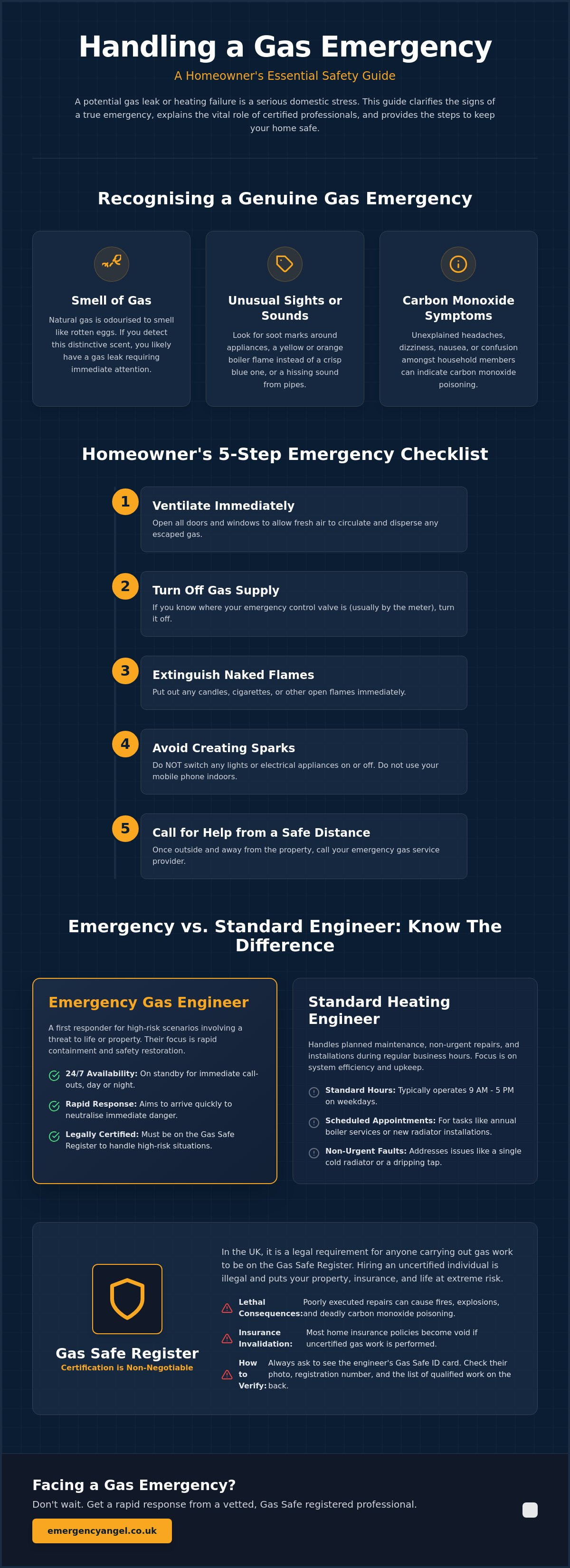
If you suspect a gas leak, your priority is safety, not diagnosis. Don't panic. You must act with the speed and precision of a first responder. Follow these five steps methodically to secure your property and protect your family. Every second counts when managing a potential fuel breach.
- Step 1: Check and extinguish. If you smell gas, extinguish all naked flames immediately. This includes candles, cigarettes, and gas hobs. Do not leave anything smouldering.
- Step 2: Ventilate the property. Open every window and door. Creating a through-draught is your best defence. It disperses the gas and prevents it from reaching a combustible concentration.
- Step 3: Shut off the supply. Locate your emergency control valve (ECV). This is usually found next to your gas meter. Turn the handle a quarter turn so it sits at a right angle to the pipe. This simple action cuts off the gas flow to the entire building.
- Step 4: Evacuate immediately. If the smell is overpowering or you feel dizzy, nauseous, or have a sudden headache, get everyone out. Don't stop to collect belongings or lock back doors. Move to a safe distance away from the structure.
- Step 5: Call for professional help. Once you are in a safe location outside, contact an emergency gas engineer to attend the site. Do not use a phone inside the affected building.
What NOT to do during a gas emergency
Your actions in the first few minutes are critical for preventing an explosion. Do not touch any electrical switches. Turning a light on or off can create a tiny, invisible spark. This is enough to ignite a gas-filled room. Avoid using landlines or plugging in appliances. Do not smoke or use matches. Most importantly, never attempt to "find" the leak yourself. Using soapy water or a flame to locate a split pipe is incredibly dangerous. Leave the leak detection to a qualified professional with calibrated gas-sniffing equipment.
Information to have ready for the engineer
Speeding up the repair process reduces your downtime and stress. When you make the call, try to have specific details ready. Provide the make and model of your boiler or gas appliance. Tell the dispatcher whether you have a pre-payment meter or a standard credit meter. If your boiler is still functional enough to show a display, look for any error codes. This data allows your emergency gas engineer to arrive with a better understanding of the fault and the likely spare parts required.
If you are facing an urgent fault right now, book an emergency boiler repair to get a vetted expert to your door immediately.
Why Emergency Angel is the UK’s choice for rapid gas response
When a gas crisis strikes, you don't have time to browse directories or hope for a callback. You need a national network that operates with the speed and precision of an emergency service. Emergency Angel bridges the gap between local expertise and national reliability. We ensure a qualified emergency gas engineer is available regardless of your postcode. From rural villages to bustling city centres, our reach is comprehensive. We don't just send a tradesman; we dispatch a specialist trained to manage high-pressure situations with a professional calm that immediately lowers the tension in your home.
Disasters don't follow a 9-to-5 schedule. A boiler failure on a bank holiday or a gas leak detected at 3 AM requires more than just a voicemail greeting. Our dispatch team remains active 24/7, 365 days a year. We treat every call with high-stakes urgency because we understand the life-safety risks involved. Our primary objective is to stabilise the situation instantly. By cutting off the danger and diagnosing the fault rapidly, we protect your property whilst standard firms are still asleep.
The Emergency Angel professional standard
Every responder in our network is a "local hero" who understands the unique stress of a domestic emergency. They combine deep expertise in both plumbing and gas to handle complex system failures that often baffle standard tradespeople. You can expect clear, jargon-free communication from the moment they step through your door. We believe transparency is the best way to earn your trust. Every step of the repair is explained, ensuring you remain in control of the process whilst we handle the technical danger. We treat your home with the respect and care it deserves, leaving you with a safe environment and a clear resolution.
Securing your home tonight
Our dispatch system is engineered for maximum efficiency. It identifies the nearest emergency gas engineer based on your specific fault and location. This precision means you aren't waiting for a technician to travel from the other side of the country. You get a local expert backed by the accountability of a national brand. This vetted network provides the ultimate peace of mind. You know that the person arriving is certified, professional, and ready to work. Don't leave your safety to chance. Contact Emergency Angel now for immediate assistance with your gas emergency and get your home back to normal tonight.
Take control of your home safety today
A gas emergency doesn't have to result in a disaster. By understanding the critical role of a Gas Safe registered emergency gas engineer, you've already taken the first step toward protecting your household. You now know how to distinguish a specialist from a generalist and, most importantly, you have a clear safety checklist to follow whilst help is on the way. Speed and certification are life-saving requirements when dealing with volatile fuel sources.
Don't wait for a minor fault to become a major hazard. Whether it's a suspected leak or a total boiler failure, immediate action provides the only path to peace of mind. Our national network is standing by to assist you at any hour. This ensures a vetted professional is always within reach to stabilise your system and secure your property.
Book a 24/7 Emergency Gas Engineer Now. Every responder in our network is Gas Safe Registered, providing national UK coverage and a rapid response for all domestic emergencies. Stay safe, stay vigilant, and let the experts handle the risk.
Frequently Asked Questions
How much does an emergency gas engineer cost in the UK?
Costs for an urgent call-out typically include a fixed attendance fee plus an hourly labour rate. These prices vary significantly based on your location and the time of day, with late-night or bank holiday visits commanding a premium. You should always clarify whether parts are included in the initial quote to avoid surprises when the invoice arrives.
Can a normal plumber fix a gas leak or a broken boiler?
No, a plumber cannot legally work on gas appliances unless they are specifically Gas Safe registered. Most plumbers focus on water systems, taps, and drainage. It is a criminal offence for anyone to touch gas-fed components without the correct legal certification, as incorrect repairs can lead to leaks or explosions.
What is the fastest way to get a gas engineer out-of-hours?
The quickest method is to use a national dispatch service that manages a vetted network of local responders. This allows you to bypass local firms that may have closed for the day. A 24/7 dispatch system identifies the nearest available specialist and sends them to your property immediately to stabilise the crisis.
How do I know if my boiler breakdown is a genuine emergency?
A breakdown is a genuine emergency if it poses a safety risk or results in a total loss of essential services during cold weather. Signs like the smell of gas, soot marks, or yellow flames require immediate attention. If your boiler is simply making a slight noise but still provides heat, it can likely wait for a standard appointment.
Is it safe to stay in the house if I smell gas but have turned the meter off?
No, you must evacuate the property even after the supply has been isolated at the meter. Residual gas can remain trapped in confined spaces, posing a continued risk of fire or inhalation. Open all windows to ventilate the building and wait for an emergency gas engineer to declare the environment safe before you re-enter.
How can I check if an engineer is actually Gas Safe registered?
Check the engineer's Gas Safe ID card as soon as they arrive at your door. Every card features a unique seven-digit registration number and a photo of the operative. You can verify these details in seconds on the official Gas Safe Register website to ensure they are qualified for the specific work required.
What happens if the engineer cannot fix the boiler during the first visit?
The primary goal of an emergency visit is to make the system safe and prevent further danger. If a specific spare part is needed that isn't immediately available, the engineer will isolate the appliance to ensure it cannot be used. They will then provide a diagnosis and a plan to return with the necessary components.
Will my home insurance cover the cost of an emergency gas call-out?
Many home insurance policies include "Home Emergency" cover that specifically handles the cost of making a system safe. This usually covers the initial call-out fee and basic labour. You should contact your provider to see if they require you to use a specific emergency gas engineer from their approved list to maintain your coverage.